

How to Cut Claim Cycle Times With Automated Medical Bill Data Extraction

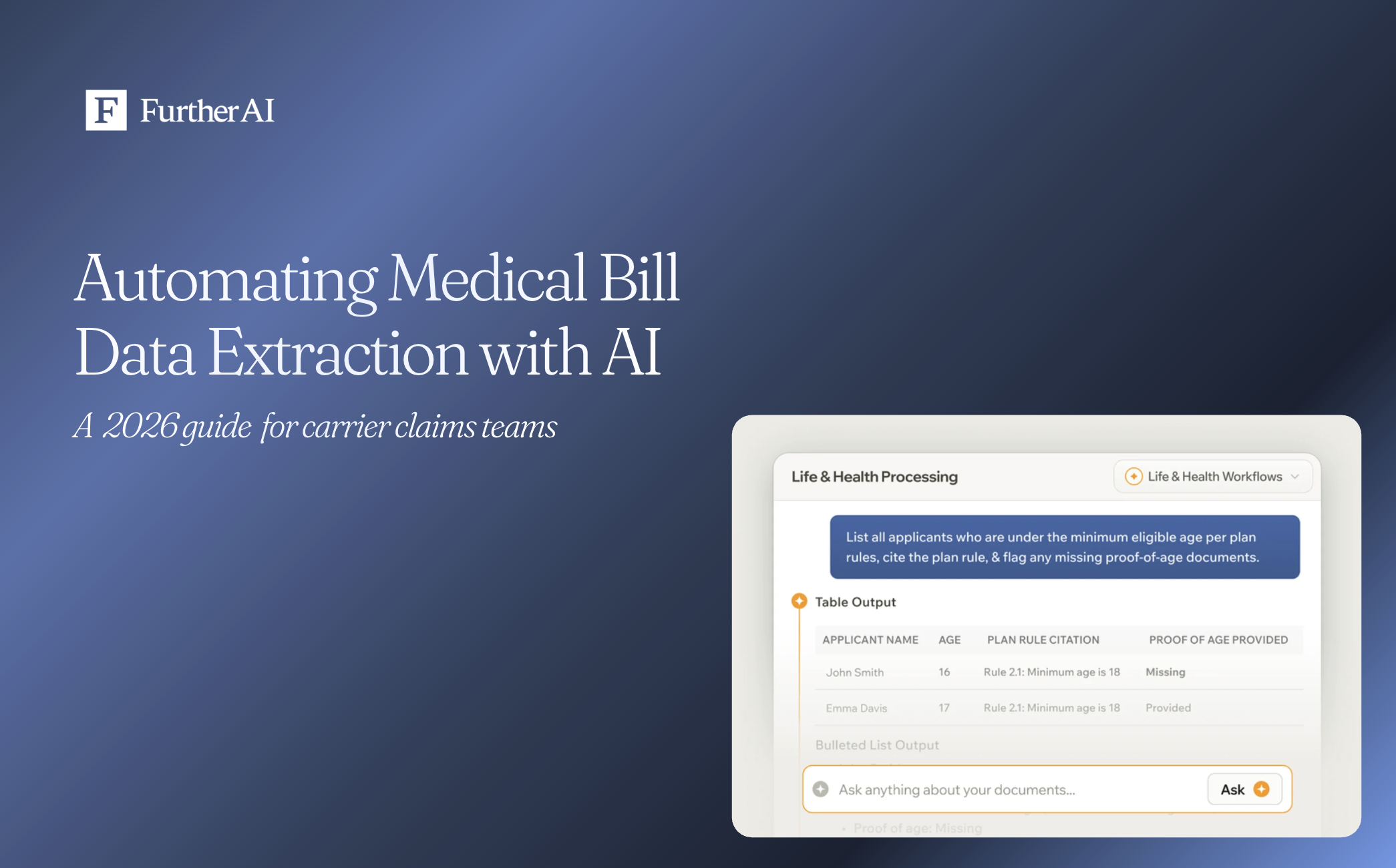
Automated medical bill data extraction software reads medical bills, repair estimates, and claim forms, then writes the captured fields straight into your claims system without manual rekeying. For carrier claims teams, that means faster first notice of loss handling, fewer denials from data errors, and cycle times measured in minutes instead of days. One specialty insurer using FurtherAI reached more than 90% automation on claim intake, cut processing time by 10x, and saved more than $360K a year — a 568% return.
In this guide, we walk you through how to get there, from mapping your intake workflow to deploying a layered extraction stack, routing exceptions, and governing accuracy over time.
Key takeaways
- Manual intake is the bottleneck. Rekeying data from bills and forms is slow, error-prone, and hard to scale. One FurtherA customer spent about 2.5 hours per claim on intake alone, roughly 7,500 labor hours a year.
- Automation pays back fast. After rewiring its claims operation with AI, UK insurer Aviva saved more than £60M ($82M) on motor claims in 2024 and cut complex-case liability assessment time by 23 days, as per McKinsey.
- Clean data prevents denials. About 90% of claim denials are preventable, so validating fields, codes, and attachments before submission avoids costly rework, as per MGMA.
- Start with high-volume documents. CMS-1500s, UB-04s, EOBs, and repair estimates deliver the fastest ROI because they're repetitive and structured.
- Keep humans on exceptions. The best systems auto-process clean claims and route only low-confidence cases to adjusters.
Map your current claims intake and manual touchpoints
Before you automate anything, document how a claim actually moves through your shop. A typical claim travels through intake, data entry, validation, exception handling, and adjudication, and each handoff is a chance for delay or error.
Walk the workflow and mark every manual extraction point — every place where someone keys data from a bill, claim form, or attachment into a carrier system. These touchpoints are where automation returns the most, because they combine high volume with low complexity. A simple process map or table listing each step, who owns it, and how long it takes will surface the bottlenecks quickly.
Manual data extraction is the process of typing or rekeying information from claim documents into carrier systems by hand. It's time-consuming, and it's the single biggest source of downstream denials and audit findings. Across healthcare, moving these manual administrative tasks to automated workflows represents a $20 billion savings opportunity, as per CAQH.
Prioritize the document types worth automating first
Not every document deserves automation on day one. Rank candidates by annual volume and rework rate, then start where repetition and error costs are highest. High-volume, standardized forms pay back faster than rare, complex ones.
Routing only exceptions from these high-volume queues keeps a full workload moving instead of stalling every claim behind a handful of hard ones.
Layer your extraction technology for accuracy
No single technique handles every document well. A layered stack pairs the right method to each data type, which is how mature systems hit high accuracy across messy, varied inputs. FurtherAI combines multiple large language models (LLMs) with insurance-specific logic so each field is captured, validated, and checked against your schema.
Optical character recognition (OCR) is software that converts scanned documents and images into searchable text. IDP adds a layer of machine learning on top, validating each field and flagging anything the model isn't confident about. NLP handles the harder cases — reading a provider's note and mapping it to the right ICD-10 or CPT code — while computer vision covers everything that isn't clean text.
Route exceptions and scrub claims before submission
Rules-based scrubbing runs automated checks to confirm that fields, codes, and attachments are present and valid before a claim moves forward. Catching a missing modifier or mismatched code at intake is far cheaper than reworking a denial after the fact, which is why leading teams push validation as far upstream as possible.
Exception routing keeps your team focused where judgment matters. Clean, high-confidence claims flow straight through; only low-confidence extractions or missing data get escalated to a human adjuster. FurtherAI's claim intake workflow validates that every incoming notice includes the required documents and field-level data, then hands complete files to adjusters and flags the rest.
Integrate extracted data with your claims and policy systems
Extraction only delivers value when the data lands cleanly in the systems your team already uses. Push captured fields into your claims management, policy administration, and electronic health record (EHR) systems through APIs, secure file drops, or direct database connections. This avoids duplicate entry and preserves a full audit trail for every field.
FurtherAI is built to be modular and integration-ready, so the extracted data gets posted into existing workflows without forcing your staff to change how they work. Preserving current processes matters — a rollout that disrupts adjusters day one rarely sticks.
Govern accuracy and track results over time
Automation isn't a one-time install. Set up governance with multidisciplinary oversight, payer-specific rules, audit logging, and clear exception management so accuracy holds as volume grows. Track denial rates, cycle times, first-pass acceptance, and extraction accuracy on a regular cadence, and retrain models as new document variants appear.
For medical data, compliance can't be an afterthought. FurtherAI runs on a HIPAA-compliant, SOC 2 Type 2 certified workspace with full audit logging, so every extracted field stays traceable from source document to system of record.
A feedback loop turns those metrics into compounding gains: adjuster corrections become training data, accuracy improves, and more claims clear straight through. McKinsey reports that domain-level AI in claims already delivers a 3 to 5% accuracy improvement, with far more headroom ahead.
What strong results look like
The specialty insurer mentioned earlier processed more than 3,000 claims a year with 98% of the workflow done by hand before automation. After deploying FurtherAI's claim intake, it reached more than 90% automation, 10x faster processing, and $360K in annual savings at a 568% ROI. Across the FurtherAI customer base, teams have posted similar gains: a carrier hit 646% ROI on property intake, and a reinsurer cut audit time by 45%, as per FurtherAI. The claims organization went from a growth bottleneck to a scalable operation without adding headcount.
Where this fits for life and health teams
Life and health (L&H) work runs on the same document problem as property and casualty, just with different paperwork. FurtherAI structures attending physician statements (APS packets), applications, census files, and medical evidence into validated case files, flagging missing data before it stalls a decision. Customers report a double-digit lift in first-pass completeness.
On the claims side, FurtherAI's Claims Document Intelligence turns EOBs, provider notes, and correspondence into searchable case records and pulls the key facts adjudicators need, which shortens time-to-adjudication and cuts follow-ups. Policy check and comparison runs about 95% faster, so L&H specialists can redline riders and exclusions in minutes and verify eligibility against product rules before a late correction turns into an audit finding.
REFERENCES
Council for Affordable Quality Healthcare. "New CAQH Index Reveals $20B Savings Opportunity to Cut Waste, Reduce Costs, and Improve Patient Access." CAQH. caqh.org
FurtherAI. "Claims Processing: A FurtherAI Claim Intake Hit 90% Automation, $360k Savings & 10x Faster Processing." FurtherAI. furtherai.com
FurtherAI. "Customer Stories." FurtherAI. furtherai.com
FurtherAI. "Life & Health: Streamline L&H Case Processing." FurtherAI. furtherai.com
McKinsey & Company. "The Future of AI in the Insurance Industry." McKinsey & Company. mckinsey.com
Medical Group Management Association. "Decrease Costs and Increase Revenue by Proactively Avoiding Denials." MGMA. mgma.com
DISCLAIMER
This article is for general informational purposes only and does not constitute legal, regulatory, compliance, underwriting, or other professional advice. The content reflects information available as of the date of publication, and FurtherAI undertakes no obligation to update it as laws, regulations, or AI technologies evolve.
Recent posts
.png)
Ready to Go Further &
Transform Your Insurance Ops?
Reclaim your time for strategic work and let our AI Assistant handle the busywork. Schedule a demo to see how you can achieve more, faster.




.svg)