

2026 Essential Guide to Automating Risk Assessment Documentation for Engineers

Key takeaways
- Automating risk assessment documentation removes the manual busywork that slows risk engineers down, and McKinsey estimates that gen AI alone could absorb nearly half of insurance's manual activities.
- The strongest platforms map every risk to a control, attach supporting evidence automatically, and keep a versioned audit trail aligned to frameworks like NIST SP 800-30, ISO 31000, and FAIR.
- Our pick for insurance and underwriting risk teams is FurtherAI, which reports 30x faster quote generation, a 67% reduction in policy comparison time, and 85% fewer underwriting audit revisions across a platform powering over $50B in written premium.
- Modern document AI is now accurate enough on common document types (with leading vendors reporting extraction rates approaching 99%) that a human-in-the-loop review model is practical rather than aspirational.
- Regulation is raising the bar: the EU AI Act's high-risk obligations for insurance risk assessment and pricing — including technical documentation and event logging — apply from 2 December 2027, as per European Commission.
Why automating risk assessment documentation matters in 2026
Risk engineers spend a large share of their week assembling evidence, updating registers, and reconciling findings across spreadsheets and email. That work is necessary, but it rarely uses the judgment these teams are actually hired for. McKinsey estimates that nearly 50% of manual activities in insurance could be handled by generative AI.
Automating risk assessment documentation means using AI-driven systems to capture, analyze, and report on risks — replacing repetitive manual entry with repeatable, auditable processes. The payoff shows up in three places: measurable time savings, a centralized risk register that serves as a single source of truth, and the scalability to monitor risk continuously instead of in quarterly bursts.
There's also a compliance clock. Under the EU AI Act, AI systems used for risk assessment and pricing in life and health insurance are classified as high-risk, triggering technical documentation, human oversight, and logging obligations that apply from August 2, 2026, as per European Commission. Teams that automate documentation now will find audit readiness is a byproduct rather than a scramble.
Risk documentation doesn't stand alone; it feeds the decisions downstream. See where it fits in the broader AI underwriting workflow.
Top solutions for automating risk assessment documentation
We compared the leading platforms a risk engineer should shortlist in 2026. Each entry below uses the same structure: a short overview, who it's best for, and a consistent set of pros and cons. The comparison table summarizes all six against the capabilities that matter most for audit-ready documentation.
1. FurtherAI
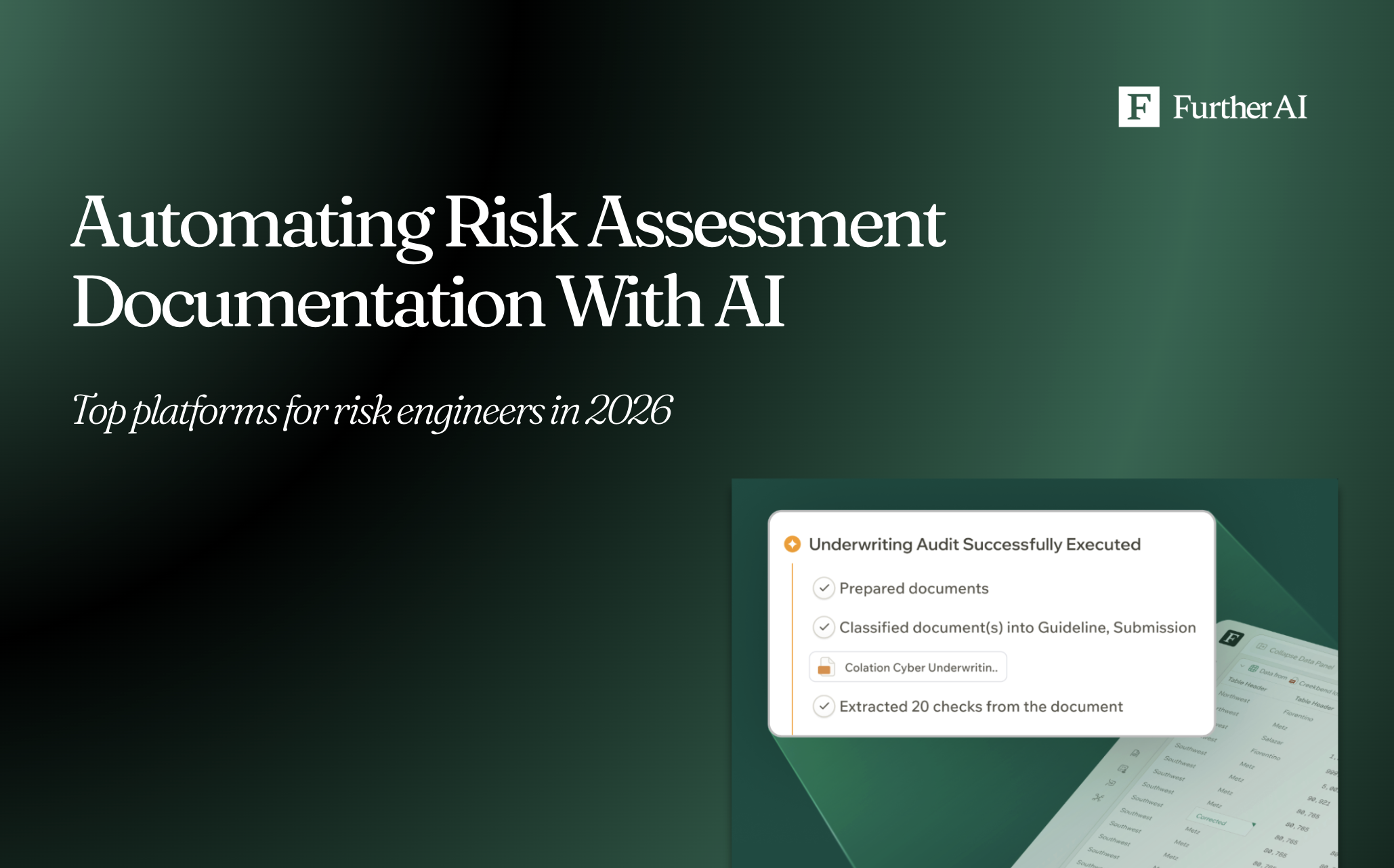
FurtherAI is a modular AI workspace built specifically for insurance, connecting to existing systems by API to automate underwriting from submission intake through final policy documentation. For risk documentation, the relevant strength is traceability: every extraction, transformation, and decision point is logged automatically, so the audit trail builds itself as work happens. The platform meets the highest security standards ( SOC 2 Type 2 compliant, ISO 27001 certified, and GDPR and HIPAA aligned) and it preserves human oversight on critical decisions.
The results are specific and customer-verified. One reinsurer cut underwriting audit time 45%, from 200 hours to 110 hours per MGA, while strengthening compliance. An MGA reached 30x faster submissions with more than 200% efficiency gains, and a claims intake workflow hit 90% automation with $360,000 in savings and 10x faster processing. As Senior Vice President at McGowan Excess & Casualty, Steve Wentz put it, the platform lets his team "get through a ton of information and uncover additional information that you need to underwrite."
Best for: insurance and underwriting risk teams — carriers, MGAs, brokers, and reinsurers — that need audit-ready documentation across the policy lifecycle.
Pros:
- Forward-deployed engineers configure workflows directly with your team, which speeds adoption.
- Automatic, end-to-end audit trail aligned to regulated environments.
- Customer-verified outcomes across submissions, audits, and claims.
Cons:
- Purpose-built for insurance, so it's less of a fit for general-purpose IT or cyber GRC programs.
- Enterprise deployment assumes API access to your core systems.
2. Kalepa Copilot
Kalepa's Copilot is an AI underwriting workbench that classifies submissions and extracts data across hundreds of document types, from ACORDs and SOVs to complex loss runs. It surfaces hidden exposures, aligns risks to appetite and guidelines, and pulls third-party and web data into a single risk view. Kalepa reports that underwriters can quote complex risks 58% faster with Copilot, a figure the vendor publishes for its commercial and specialty customers.
Best for: commercial and specialty underwriting teams focused on faster, sharper risk selection.
Pros:
- Strong document classification and loss-run analysis.
- Risk prioritization tied to appetite and guidelines.
- Broad third-party data enrichment.
Cons:
- Centered on risk selection rather than full compliance documentation.
- Performance claims are vendor-reported and worth validating in a pilot.
3. Cytora
Cytora is an agentic platform that automates risk workflows end to end. Its Autopilot product orchestrates intake, identifies missing data, and scores and prices risks, aiming to move underwriting and claims teams from reviewing submissions manually to supervising a self-executing flow of risk. The company notes that teams can spend up to 50% of their time on submission review and broker follow-ups before automation.
Best for: commercial insurers that want to automate high-volume intake and triage.
Pros:
- Agentic orchestration across the risk workflow.
- Configurable scoring and pricing models.
- Designed to reduce manual data-chasing.
Cons:
- Heavier lift to configure for niche or non-standard lines.
- Documentation and evidence features are part of a broader workflow suite.
4. Federato
Federato offers an AI-native, full policy-lifecycle platform for property and casualty underwriting. Its agentic AI supports analysis and decision-making across underwriting, and its Control Tower module adds real-time portfolio management with governance, visibility, and strategy alignment — useful when risk documentation needs to roll up to a portfolio view.
Best for: P&C underwriting and portfolio teams that need governance alongside individual risk decisions.
Pros:
- Portfolio-level visibility and governance.
- Agentic support across the underwriting lifecycle.
- Built with input from dozens of P&C insurers.
Cons:
- Portfolio orientation may exceed the needs of a single documentation workflow.
- Best suited to P&C rather than cyber or operational risk.
5. Sia Underwriting Intelligence Platform
Sia's Underwriting Intelligence Platform automates property risk assessment by combining high-resolution aerial imagery, geospatial hazard APIs, and vision-language models. It produces underwriting-grade narratives with source traceability, so the documentation carries its own evidence trail. Sia frames the tool as strengthening expert judgment rather than replacing it.
Best for: property risk engineers who need imagery- and location-based hazard assessment.
Pros:
- Rich geospatial and imagery-based risk signals.
- Source-traceable narratives support auditability.
- Explainable, human-in-the-loop design.
Cons:
- Specialized for property and natural-hazard risk.
- Narrower scope than a full-lifecycle underwriting platform.
6. Vanta
For cyber and GRC risk engineers, Vanta automates continuous control monitoring and compliance evidence across frameworks such as SOC 2 and ISO 27001. It maintains a risk register, links controls to evidence, and keeps documentation current as systems change — the GRC analog to the underwriting tools above.
Best for: cyber and operational risk engineers managing information-security compliance.
Pros:
- Continuous monitoring and automated evidence collection.
- Strong framework coverage for security compliance.
- Centralized, always-current control documentation.
Cons:
- Built for security and IT GRC, not insurance underwriting.
- Less suited to risk pricing or coverage analysis.
How to implement risk documentation automation
Choosing a platform is half the work. The other half is a disciplined rollout. The steps below follow the sequence most successful risk teams use.
Define scope and select risk frameworks
Set your taxonomy and frameworks before you automate anything. NIST SP 800-30 provides the foundational guide for conducting risk assessments, ISO 31000 offers broad risk-management guidelines, ISO/IEC 27005 tailors that approach to information security, and the FAIR model adds quantitative, financial-loss-based scoring. Map each framework to your compliance obligations up front so the automation inherits the right structure. Your risk register — the definitive, auditable record of every identified risk and its mitigation plan — sits at the center of this.
Inventory systems and assign ownership
Enumerate every asset that carries risk: systems, applications, AI models, cloud services, and shadow IT. Build a RACI matrix so documentation and risk ownership are unambiguous, and use a structured template to catalog assets, data flows, owners, and risk attributes. Keep it living; new integrations and models appear constantly, and stale inventories are where audit gaps hide.
Choose integration-ready tools and configure scoring
Prioritize platforms with API connectors into the systems you already run — SIEM, ITSM, IAM, cloud providers, ticketing, and underwriting or project-management tools. Then configure your scoring model. Qualitative methods use scales for speed; quantitative methods, including FAIR, use numeric models to express top risks in financial terms. Map controls directly to compliance requirements so evidence generates itself and audit workload drops.
Automate evidence collection with humans in the loop
Let the platform gather logs, configurations, and approvals, deduplicate them, and attach them to the right risks and controls. Because modern document AI now handles common document types with high accuracy — leading vendors report extraction rates approaching 99% — you can automate the high-volume work and reserve human review for edge cases, novel risks, and exceptions. That hybrid model is what keeps automated documentation both fast and defensible.
Pilot, measure, and operationalize
Run a focused pilot on a high-volume, repetitive process. Establish a baseline — time-to-mitigation, audit hours, percentage of active risks resolved — then measure against it. The reinsurer that cut audit time from 200 to 110 hours per MGA started exactly this way, with a contained scope and a clear before-and-after. Once the numbers hold, expand to continuous monitoring, schedule regular evidence generation, and add governance for model drift, data bias, and explainability.
Balancing automation and human oversight
Automation should carry the repeatable load — data collection, scoring, evidence attachment, and register updates. Human judgment stays in control of policy exceptions, novel or higher-order risks, and any decision a regulator will scrutinize. Keep clear escalation steps, document who signs off on what, and review the model's outputs on a schedule. Done this way, you get the speed of automation and the accountability auditors expect.
See how FurtherAI automates audit-ready risk documentation
If you're evaluating these solutions, FurtherAI is the option built for insurance from the ground up, with verified outcomes across underwriting audits, submissions, and claims. Book a demo to see audit-ready documentation in your own workflows.
REFERENCES
European Commission. "AI Act | Shaping Europe's Digital Future." European Commission. digital-strategy.ec.europa.eu
EU Artificial Intelligence Act. "Annex III: High-Risk AI Systems Referred to in Article 6(2)." artificialintelligenceact.eu. artificialintelligenceact.eu
FAIR Institute. "What Is FAIR." The FAIR Institute. fairinstitute.org
FurtherAI. "AI Platform Powering $50B+ in Written Premium." FurtherAI. furtherai.com
FurtherAI. "Claims Processing." FurtherAI. furtherai.com
FurtherAI. "Customer Stories." FurtherAI. furtherai.com
FurtherAI. "Submissions Processing." FurtherAI. furtherai.com
FurtherAI. "Underwriting Audit." FurtherAI. furtherai.com
International Organization for Standardization. "ISO 31000:2018 — Risk Management Guidelines." ISO. iso.org
International Organization for Standardization. "ISO/IEC 27005:2022 — Guidance on Managing Information Security Risks." ISO. iso.org
McKinsey & Company. "Shiny Objects: Insurance Productivity in an Era of AI and Automation." McKinsey & Company. mckinsey.com
National Institute of Standards and Technology. "SP 800-30 Rev. 1, Guide for Conducting Risk Assessments." NIST CSRC. csrc.nist.gov
DISCLAIMER
This article is for general informational purposes only and does not constitute legal, regulatory, compliance, underwriting, or other professional advice. The content reflects information available as of the date of publication, and FurtherAI undertakes no obligation to update it as laws, regulations, or AI technologies evolve.
Recent posts
.png)
Ready to go further and
transform your insurance ops?
Reclaim your time for strategic work and let our AI Assistant handle the busywork. Schedule a demo to see how you can achieve more, faster.




.svg)