

8 Trusted Software Solutions for Insurance Audit Readiness in 2026


Summary
The 8 best insurance audit readiness software tools in 2026 are FurtherAI (AI workflow layer for underwriting and compliance), Guidewire InsuranceSuite (P&C system of record), ZenGRC (compliance workflow), Agenzee (multi-state licensing), ComplyAdvantage (AML and sanctions screening), Onspring (configurable GRC), Vanta (audit automation), and MetricStream (enterprise GRC). The right choice depends on your line of business, entity count, and whether your audit gaps live in operations, controls, or financial-crime compliance.
What is insurance audit readiness
Insurance audit readiness is the practice of maintaining verifiable records, controls, and documentation so carriers, MGAs, and brokers can respond to regulators, market conduct examiners, and internal auditors at any point in the year, not just at year-end.
The 2024–2026 regulatory cycle has made continuous readiness non-negotiable: U.S. state insurance departments collected $190.6 million in fines and penalties in 2024 (R Street Institute), the NYDFS Second Amendment to 23 NYCRR Part 500 phased in personal CISO certification through November 2025, and the NAIC Model Bulletin on AI has been adopted in roughly half the states.
The platforms below are the ones insurance teams most frequently use to keep evidence current, controls testable, and documentation defensible. We start with FurtherAI, an AI workflow layer that complements every other platform on this list, and then walk through the seven systems of record, GRC tools, and compliance specialists most relevant to insurance.
How we evaluated these platforms
We compared each tool across six criteria specifically relevant to insurance audit readiness:
- Insurance fit: Designed for carriers, MGAs, brokers, or financial services
- Workflow coverage: Submission intake, underwriting, claims, licensing, financial crime, IT controls
- Auditability: Native audit trails, source citations, evidence trails, version history
- Integration: Connects to policy admin (Guidewire, Duck Creek), claims, CRM, HRIS, and identity systems
- Regulatory alignment: Coverage of NAIC MAR, NYDFS Part 500, SOX 404, SOC 2, ISO 27001, AML
- Scalability: Multi-entity, multi-jurisdiction, multi-line support
Quick comparison: Audit readiness software for insurance
1. FurtherAI
FurtherAI is a domain-specialized AI platform that runs core insurance workflows ( submission intake, policy comparison, underwriting audit, claims, and compliance) and produces structured, source-cited outputs as a byproduct.
Founded in 2024 and backed by a $25M Series A from Andreessen Horowitz, FurtherAI is purpose-built for insurance and processes billions in premiums each year for customers including Accelerant, MSI, and Leavitt Group.
Best for: Carriers, MGAs, and brokers whose audit gaps live inside document-heavy operational workflows ( submission triage, policy checking, underwriting QA, and claims intake) rather than in IT controls.
Audit-relevant capabilities:
- Submission intake and document normalization (broker emails, ACORDs, SOVs, loss runs) up to 30× faster than manual processing
- Policy check and compare workflows that surface coverage changes, gaps, and endorsement deltas with inline citations
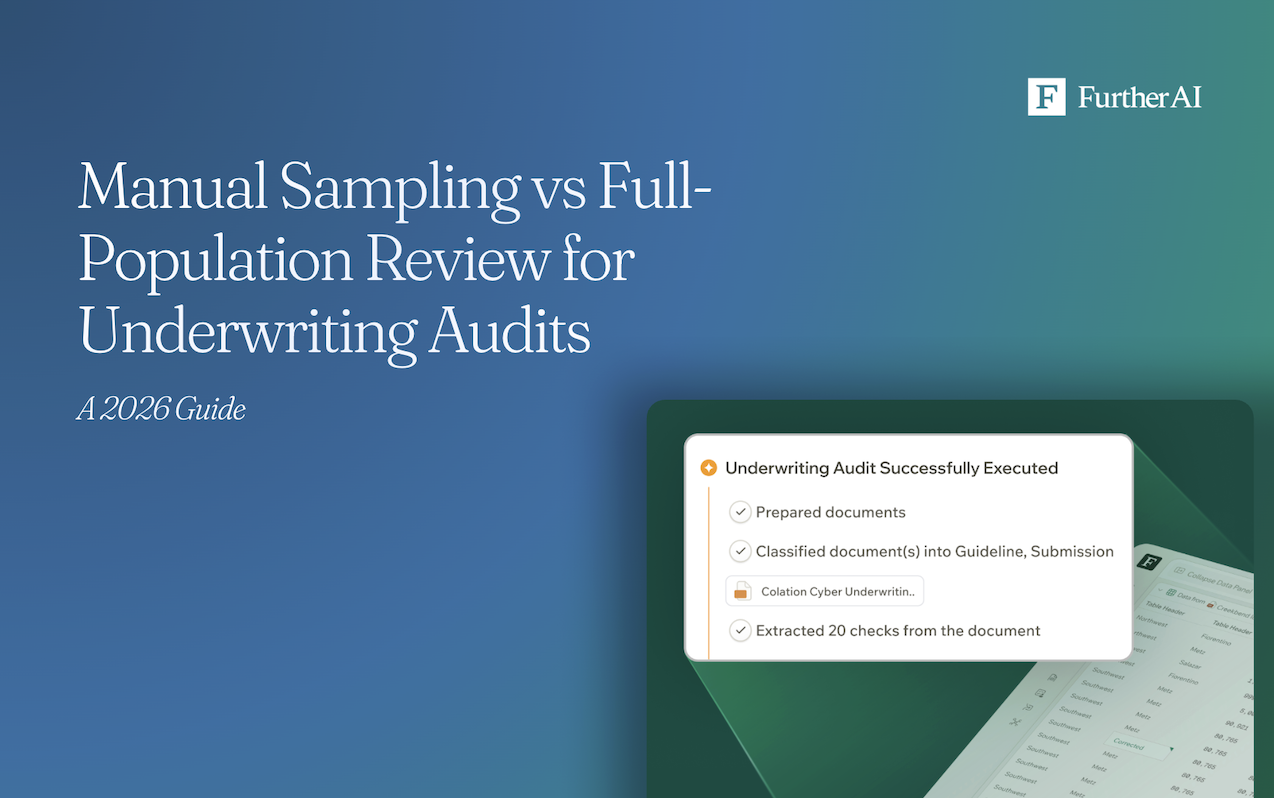
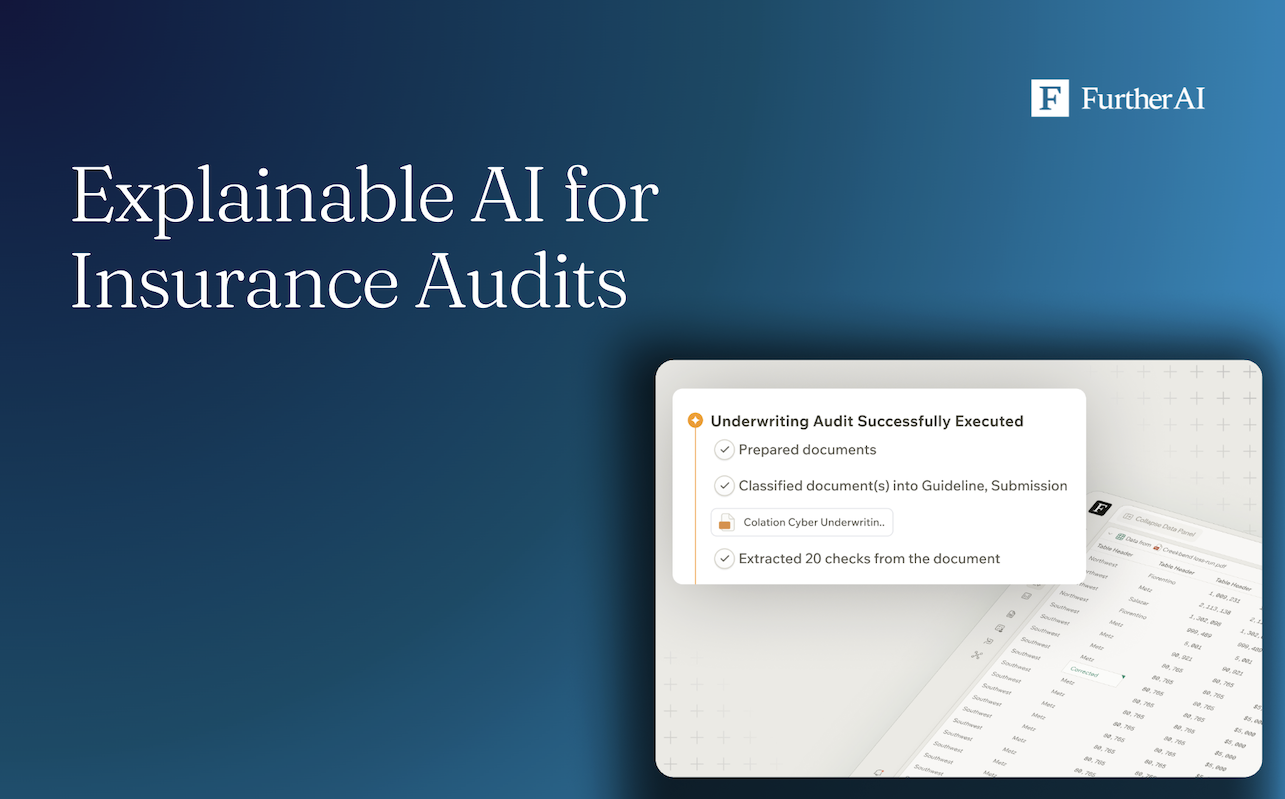
- Underwriting audits and operational quality reviews with reviewer-in-the-loop workflows
- Claims intake and compliance-adjacent document validation
- Repeatable review workflows that preserve source references and evidence trails for regulators
Integration: Embeds into existing policy administration, claims, and content systems, including Guidewire InsuranceSuite, Duck Creek, Salesforce, and email/inbox systems. As teams extend FurtherAI from one workflow into adjacent processes, audit readiness improves naturally because documentation is already structured, reviewable, and traceable.
Pricing: Custom enterprise pricing; contact sales for a workflow-scoped pilot.
Limitations: FurtherAI complements, but does not replace, a GRC platform or system of record. Teams that need ICFR control libraries, third-party risk registers, or SOC 2 evidence automation should pair it with a tool from the list below.
Audit readiness breaks down when evidence has to be reassembled after the fact — by then, the trail is cold and the context is gone. FurtherAI solves that by embedding source-cited AI directly into the workflows that generate audit evidence in the first place, with inline citations, reviewer-in-the-loop checkpoints, and every output captured as structured data in a clean, organized record that stays queryable long after the work is done. The result is documentation that's defensible by default and instantly retrievable today or tomorrow, aligned with NAIC AI Model Bulletin expectations around traceability and human oversight. — Danny O'Lenic, Product Lead at FurtherAI
2. Guidewire InsuranceSuite
Guidewire InsuranceSuite is the dominant cloud-based system of record for P&C insurers, combining PolicyCenter, ClaimCenter, and BillingCenter with native audit trails across the policy lifecycle. Its April 2026 Palisades release added the ProNavigator AI assistant with role-based access controls, automated retention policies, and finance-team payment reconciliation with detailed funds tracking.
Best for: Mid-size to large P&C carriers that need a single source of truth for policy administration, claims, and billing across jurisdictions.
Audit-relevant strengths: A unified audit trail spans the entire content lifecycle ( historical records, active documents, and outbound correspondence) and integrates with regulatory tracking and task management modules used in market conduct examinations.
Limitations: Implementation cost and time-to-value are substantial; smaller MGAs and brokers typically pair with a lighter compliance layer.
3. ZenGRC (formerly RiskOptics)
ZenGRC is a continuous, end-to-end GRC platform that helps teams document controls, automate evidence collection, and manage audits with less manual coordination. The product was renamed RiskOptics in 2023 and returned to the ZenGRC name in 2024, now offered alongside ZenGRC Pro (the former ROAR platform).
Best for: Mid-market and enterprise insurance organizations standing up SOX 404, NAIC Model Audit Rule (MAR), or SOC 2 control programs.
Audit-relevant strengths: Pre-mapped frameworks for SOC 2, ISO 27001, HIPAA, and PCI; automated evidence capture; centralized reporting; and a control library that reduces duplicate evidence across audits.
Limitations: Less specialized for insurance-specific workflows like producer licensing or claims handling than insurance-native tools.
4. Agenzee
Agenzee is an insurance-native compliance platform that combines daily NIPR synchronization with AI and automation to manage producer and entity licensing across all 50 states. It is purpose-built for the unique licensing burden facing agencies, carriers, and MGAs.
Best for: Agencies, MGAs, and carriers managing multi-state producer licenses, appointments, and entity licenses.
Audit-relevant strengths: Live NIPR data integration keeps producer and entity license statuses current, automates renewal workflows, and produces auditable licensing records that align to state DOI and NAIC Producer Licensing Model Act requirements. Background-check workflows and configurable approval steps reduce common market conduct findings around producer licensing.
Limitations: Scope is licensing, not financial controls or IT compliance. Best paired with a broader GRC tool.
5. ComplyAdvantage
ComplyAdvantage is an AI-driven AML, sanctions, and PEP screening platform that automates up to 95% of reviews and updates sanctions lists within minutes rather than days. Its watchlists cover OFAC, EU, HMT, and 60+ additional jurisdictions.
Best for: Life, health, specialty, and surplus lines insurers and brokers subject to AML obligations, plus carriers underwriting complex risks where adverse media screening is material.
Audit-relevant strengths: Real-time intelligence feeds, configurable risk rules, audit-ready investigation workflows, and a 4.6 G2 rating make it one of the most-cited financial crime tools for insurers in 2025.
Limitations: Focused on financial crime compliance, not a general-purpose audit, control, or licensing platform.
6. Onspring
Onspring is a no-code GRC platform that unifies compliance, risk, audit, and vendor management in a single configurable workspace. In 2024 it launched Onspring AI, powered by Anthropic's Claude models, to summarize SOC 2 reports, suggest control mappings, and detect duplicate records.
Best for: Mid-market and enterprise insurers with non-standard workflows that need to be configured, not coded.
Audit-relevant strengths: Centralized control libraries, workflow automation, real-time dashboards, and integrations with Microsoft 365, Google Drive, DocuSign, and Slack reduce the need to assemble audit evidence from disparate systems. Recognized in Gartner Peer Insights and used by federal agencies via Onspring GovCloud.
Limitations: Heavy configuration upfront; teams without GRC ownership often see slower time-to-value.
7. Vanta
Vanta is the leading audit and compliance automation platform for SOC 2, ISO 27001, HIPAA, PCI DSS, and 35+ other frameworks, running 1,200+ continuous tests hourly and serving 12,000+ customers. It is widely used by InsurTech vendors, MGA platforms, and digital brokers that handle PII or PHI.
Best for: InsurTechs, digital MGAs, and brokers preparing for SOC 2, ISO 27001, or HITRUST audits — and any insurance organization that needs to share scoped evidence with external auditors.
Audit-relevant strengths: Hourly evidence collection, auditor-friendly access controls, a dedicated auditor portal, and reported 50% reduction in audit completion time. Strong fit for cyber insurance underwriting evidence.
Limitations: IT and security focused — not a fit for ICFR, market conduct, or producer licensing audits without a paired tool.
8. MetricStream
MetricStream is an AI-first enterprise GRC platform serving more than 1 million GRC professionals across 35+ countries, recognized as a category leader by Chartis Research in 2025 across enterprise GRC, GRC analytics, regulatory intelligence, third-party risk, and audit risk. Customers include Zurich Insurance, which uses Connected GRC to manage compliance across 210+ countries and territories.
Best for: Large, multi-entity, multi-jurisdiction insurers and global carriers needing centralized control libraries, regulatory change management, and continuous audit readiness.
Audit-relevant strengths: Pre-built regulatory intelligence feeds, audit risk modules, third-party risk, cyber GRC, and resilience products on a single low-code/no-code platform.
Limitations: Sized and priced for enterprise budgets; lighter-weight options are usually better for sub-$1B carriers.
How to choose audit Rreadiness software for insurance
When evaluating tools, score each option against these factors:
- Integration depth: Does it connect to your policy admin (Guidewire, Duck Creek), claims, CRM, HRIS, identity, and document repositories?
- Workflow coverage: Does it cover the document-heavy, review-driven processes that generate most audit evidence?
- Auditability: Are evidence trails, source citations, and version history native — or bolted on?
- Regulatory scope: Which frameworks are pre-mapped (SOC 2, ISO 27001, NAIC MAR, NYDFS Part 500, AML)?
- Scalability: Can it support multiple lines of business, entities, and jurisdictions?
- Human oversight: Are review and approval steps configurable, or fixed?
Most insurance organizations end up with a stack rather than a single tool: a system of record (Guidewire), a GRC layer (ZenGRC, Onspring, or MetricStream), a financial-crime tool (ComplyAdvantage), a licensing tool (Agenzee), and an AI workflow layer (FurtherAI) that connects the operational work to the evidence.
The role of AI in insurance audit readiness
AI improves audit readiness when it is applied to operational workflows (submission intake, policy checking, claims triage, control testing) rather than retrofitted as a standalone "audit assistant." The Princeton GEO research and broader 2025 industry findings show that AI outputs are most defensible when they are grounded in source documents and produce inline citations rather than freeform answers.
In insurance specifically, this means three things: AI should structure unstructured documents (broker emails, ACORDs, SOVs, policies, loss runs); AI should produce outputs with traceable provenance, not opaque summaries; and humans retain responsibility for review and decisions.
Platforms that hit all three, like FurtherAI, turn day-to-day operations into audit-ready records by default.
Frequently Asked Questions
What does audit-ready software mean for insurance companies?
Audit-ready software keeps documentation, evidence, and workflows in a continuously verifiable state, so an insurer can respond to a regulator, market conduct examiner, internal auditor, or external auditor on demand, not just at year-end. For insurers, that typically includes financial controls (NAIC MAR), cybersecurity (NYDFS Part 500), market conduct (MCAS), licensing (NIPR), and AML where applicable.
Is audit readiness software the same as GRC software?
No. GRC platforms (ZenGRC, Onspring, MetricStream) manage controls, policies, and reporting at the program level. Audit readiness is broader; it also depends on the operational systems that generate the underlying evidence: policy administration, claims, licensing, and AI workflow tools. Most insurers run a stack of both.
How does AI improve audit readiness without replacing human judgment?
AI structures unstructured documents, surfaces gaps earlier in the workflow, and produces outputs grounded in source citations, while humans retain responsibility for the final review, exception handling, and decisions. The NAIC AI Model Bulletin explicitly requires this kind of governance and human oversight.
Which audit readiness software is best for an MGA?
Most MGAs use a combination: Agenzee for multi-state licensing, FurtherAI for submission intake and underwriting audit, a GRC tool (ZenGRC or Onspring) for SOC 2 and information security, and ComplyAdvantage if they have AML obligations. Pure GRC platforms alone rarely cover the producer licensing burden.
What is the cheapest audit readiness software for insurance?
Vanta and ZenGRC are typically the most accessible price points for InsurTechs and smaller brokers focused on SOC 2 or ISO 27001. Insurance-specific licensing and operational tools (Agenzee, FurtherAI) are usually quoted based on volume, lines of business, or workflow scope.
How often are insurance market conduct exams performed?
Market conduct examinations typically run on a 3–5 year cycle per state, supplemented by targeted exams. As of the 2024 data year, 51 jurisdictions participate in NAIC MCAS, and the 2024 data year added pet insurance as a new line of business.
Can these tools support continuous compliance, not just point-in-time audits?
Yes. Platforms like Vanta, MetricStream, and Onspring run continuous control monitoring, while operational AI workflow tools like FurtherAI generate evidence trails as a natural byproduct of in-production work. The combination is what enables true continuous audit readiness.
Recent posts
.png)
Ready to go further and
transform your insurance ops?
Reclaim your time for strategic work and let our AI Assistant handle the busywork. Schedule a demo to see how you can achieve more, faster.




.svg)